It was a tie; the heavenly vote was split right down the middle - two
in favor;
two against. At issue - “Should man be created?” The ministering angels
formed
parties: Love said, “Yes, let him be created, because he will dispense
acts of love”;
while Truth argued, “No, let him not be created, for he is a
complete fake”. Righ-
teousness countered, “Yes, let him be created, because he
will do righteous deeds;
and Peace demurred, “Let him not be created, for he is
one mass of contention”.
The score was even. Love and Righteousness in favor,
Truth and Peace against.
What did the Lord do? He took Truth and hurled it to the ground,
smashing
it into thousands of jagged pieces. Thus he broke the tie. Now, two to
one in favor,
man was created. The ministering angels dared to ask the Master of
the Universe,
“Why do You break Your emblem, Truth?” for indeed Truth was His
seal and
emblem. He answered, “Let truth spring from the earth”.
1
Ne voit-on pas qu’il y a cette différence entre Dieu et l’âme de
l’homme, que
Dieu est l’Etre sans restrictions, l’Etre universel, l’Etre infini,
et que l’âme est un
genre d’être particulier? [...] Dieu [...] connait ce qu’il a
fait avant même qu’il y
eut rien de fait. Mais l’âme ne peut voir en elle ce
quelle ne renferme pas; elle ne
peut même voir clairement ce quelle renferme;
elle ne peut que le sentir confuse-
ment.
2
[...] quod nos nisi homines sumus... 3
The Academia dei Lincei, that co-sponsors this colloquium, is
very rele-
vant for the topic of my talk. For I am going to speak about the
Leibniz
that views the achievement of knowledge as a collective/cooperative enter-
prise.
For this purpose, as is well-known, he strived to create scientific
academies and
similar organizations, and he sometimes mentioned the
Academia dei Lincei as an example to be praised. This aspect of
his activity
is usually ranged under the heading of “scientific policy”, and not
much
philosophical significance is granted to it. I believe, however, that such
a
policy, like many other “practical” endeavors he undertook, is
intimately
connected with “theory”: it stems from the need - both theoretical
and
practical - to develop an epistemological praxis capable to lead us,
finite
humans, to acquire and increase our knowledge of “reality”, as it is
con-
ceived in terms of Leibniz’s metaphysics. Leibniz’s efforts to cope with
this
need led him to the acknowledgment of epistemological diversity as an
asset
to be exploited rather than as a liability to be overcome. This amounts to
a
kind of epistemological eclecticism - some of whose aspects I want to
ex-
plore in the present paper.
For a start, let us address the topic of this symposium, namely unity and
diversity
in Leibniz’s thought, by considering his “system”, as represented in
the ensemble of
his oeuvre. We may undertake this task in two ways. (A)
Tak-
ing advantage of our ex post factum vantage point, we
may examine the oeu-
vre as a more or less complete whole,
with the purpose of finding the
thread(s) that unify it, i.e., the “systematicity”
that connects all or at least
most of its ramifications, and thereby also accounts
for whatever diversity it
displays. (B) We may try to put ourselves in the place of
Leibniz as he is
pulled by a variety of interests, tasks, problems, and
circumstances, at differ-
ent stages of his career, striving to appropriate as much
as he can from avail-
able knowledge coming from different sources, elaborating his
own views in
many different areas, and eventually systematizing them partially and,
hope-
fully, also globally. Approach (A) considers the system as a given, and
ac-
counts for its unity and diversity, as it were, sub specie
aeternitatis, while ap-
proach (B) considers the system in-the-making, as a continuous struggle to
produce unity out of
contingently encountered diversity. Broadly speaking -
and, as we will see, somewhat
misleadingly - approach (A) can be dlibbed
“struttural”, whereas approach (B) can be
dubbed “genetic”.
Most of the attempts to answer the question of the unity and diversity
of a
philosopher’s thought tend to take approach (A), for, presuming that
philosophy is systematic, they assume the existence of some
underlying
unity, to which the diversity of the philosopher’s productions must
ulti-
mately be reduced. This unifying “core” may consist in a key idea or theme,
a
concern with a special kind of problematic, a method of argumentation
and
exposition, a set of basic principles, etc. The reduction of diversity to
unity
usually takes the form of retrieving and/or reconstructing the author’s
(often
implicit) deductive chain - what Gueroult called “the order of rea-
sons” - that
leads from the latter to the former. Some philosophers, like
Descartes, Spinoza or
Kant, who tried to present their own work in a
tightly systematic/deductive way, are
more fit than others to this type of ap-
proach - provided one conveniently
overlooks the steps through which they
painstakingly reached the stage of (global)
systematization.
In Leibniz’s case, though it is harder to ignore the steps since their
traces can be
found everywhere in his corpus, there are enough
recurrent
themes, principles, projects, declarations, plans, and architectonic
sketches
to permit this kind of approach to his thought. It was in fact taken by
some
of the greatest interpreters of Leibniz, and led to the well-known
attempts
to provide an overarching “formal” structure of his system, whose
“core”
each of these interpreters believed to lie in a different layer of
Leibniz’s
work - e.g., logic, epistemology, metaphysics, mathematics, mystical
theol-
ogy, semiotics, or jurisprudence.
Given the inability of each of these proposed reductions to account de-
ductively
for large portions of the leibnizian oeuvre, Michel Serres
(1968)
proposed the ingenious hypothesis that the systematicity of Leibniz’s
system
is of a different kind. Rather than being strictly deductive, it is
“analogical”.
The system would thus be grounded in (and would illustrate) the
metaphys-
ical-semiotic notion of “expression”: just as each monad mirrors the
totality
of the universe, so too each segment of the system mirrors the system as
a
whole; none of them, therefore, is the core out of which
all the rest flows,
and all of them are legitimate and fruitful “entries” or “points
of view”
through which the whole can be accessed - in fact, only in such
multi-per-
spectival way can the unity of the system be grasped. This is a
tempting
suggestion, and it has been well documented by Serres. Yet, perhaps
even
more than the deductive reductions, it grants the author of such a system
a
capacity of design that approaches omniscience and omnipotence.
I do not dispute the fact that Leibniz’s writings are connected to each
other in an
impressive variety of ways, both deductive and analogical. But
neither I nor, I
presume, Leibniz, would like to account for this fact in terms
of the unfolding of a
system completely designed and, thus, entirely prefig-
ured in Leibniz’s juvenile
mind or, for that matter, in his monad. For this rea-
son, I think it wise to
distinguish the “genetic” approach (B) sketched above
from a kind of genetic
reductionism that merely replaces the “logical” core
by a “genetic” one. On such a
view, the aim is to reconstruct the evolutionary
story of the system, showing how the “genes” (or rather their cultural
coun-
terparts, the “memes”, to use Dawkins’s (1976) terminology) that define
its
unity/identity survive through the system’s successive adaptations to
the
challenges of the changing theoretical and practical “environment”.
4
In terms of leibnizian metaphysics, it is true that the individual sub-
stance
“Leibniz” must contain, from the moment of its inception, the total-
ity of the
productions that the human being Leibniz will ever put forth. It is
also true that
such productions unfold due to the inner law that commands
and unifies the
activities of that individual substance. Yet, these metaphysi-
cal claims refer to
the realm of divine, not human, design. While we hu-
mans may form an idea of the
divine principles that rule over the universe,
we are unable - due to our essential
limitations - to know the infinity of de-
tails that flow from such principles. That
is to say, the details of his doings
(which include his thinkings) and of their
gradual unfolding are not known
nor knowable in advance by the individual human
being Leibniz, who must
exercise his best judgment and freedom of choice, under
conditions of un-
certainty and finitude, in order to implement a divine design
which be-
comes known to him only in bits and pieces. His problem as a limited
hu-
man knower is to plan and coordinate his epistemic efforts so as to yield
as
much knowledge of the divinely designed universe as can be gathered
from
those bits and pieces.
Properly understood, approach (B) undertakes to study the construc-
tion of
systematic knowledge from the point of view of such an epistemi-
cally limited human
knower. At the theoretical level, it purports to identify
the epistemological
options open to such a knower in the light of the
philosopher’s conceptual
framework. At the factual level, it studies the
philosopher’s actual system-building
or unity-building recommendations
and practices, which may or may not conform with
the theoretical con-
straints; either way, they reveal the implications of such
constraints. Such a
study may also provide valuable indications about the
philosopher’s pre-
ferred option, which in turn may be of theoretical significance.
It is such an
approach that I will try to apply to Leibniz, within the limitations
of this
paper.
Leibniz’s metaphysics suggests two quite different epistemological
strategies. Since
each monad expresses the totality of the universe, one
strategy might consist in the
in-depth study of a single monad. The goal
would be to transform into clear and
distinct knowledge what it expresses
or “knows” only confusedly - or, in the
language of the 1678 paper Quid
sit idea, to transform the
“distal” ideas (in the sense of “remote capacity of
thinking of all things”), which
are impressed in us, into “proximal” ideas
(in the sense of a “near ability to think
about a thing”) (GP VII, 263). In
this way one would acquire knowledge not only of
the particular monad
studied, but of the rest of the universe as well. The most
natural monad for
a researcher to study in depth would be the one she is most
directly and in-
timately acquainted with, namely itself. In fact, according to the
mature
doctrine presented in paragraph 26 of the Discours de
Metaphysique (1686),
which espouses (with modifications) the Platonic theory
of reminiscence,
this would be the only epistemological
alternative, since it is a mistake to
believe that our soul has “doors and windows”
through which “messengers”
bringing information from the “outside” can penetrate:
hence, “nothing
can be taught us the idea of which is not already in our minds, as
the mat-
ter out of which our thought is formed” (GP IV, 451; L 320).
Regardless of its eventual exclusive status, such a self-centered strategy
would
have its own merits. For example, it would provide one of the two
kinds of
undemonstrable propositions upon which all knowledge is based,
namely those
consisting in “an inner experience which cannot be further
rectified by indices or
testimony, because it is immediately present to me
and there is nothing between it
and myself, e.g. the propositions I am, I
feel, I think, I want
this or that thing”
5
In addition to being undemonstra-
ble and incorrigible, the propositions given
in inner experience are also
prior “in the order of knowledge” to those that are
prior “in the order of
nature”, i.e., the necessary truths.
6 Furthermore, they are those that afford
us to learn that there are things
other than ouserlves, which cause the vari-
ety in our thoughts (GP I, 372).
In spite of its metaphysical pedigree and epistemologically grounding
status,
Leibniz doesn’t seem to be happy with the self-centered strategy.
Perhaps because
its implementation in the 17th century had been epito-
mized by Descartes’s cogito-based procedure in the Meditations
and, as is
well-known, Leibniz over the years became very critical of
Cartesianism.
7
According to Leibniz, Descartes’s emphasis on the power of pure in-
tellectual
intuition - the “natural light” of the intellect - was completely
mistken. Its
general rule, namely, that “whatever I perceive clearly and dis-
tinctly is true” is
unreliable, for “one must have signs (marques) of what
is
clear and distinct; otherwise the visions of those self-praising persons
who
mention all the time their ideas would be authorized” (GP I, 384).
8 Such
signs include, first, the elaboration of (nominal) definitions which
transform
clear but confused ideas into distinct ones, for - unlike Descartes -
for
Leibniz not all clear ideas are distinct, and only through the latter can one
attain general demonstrable
propositions.
9 But even such definitions are
logically insufficient, because, not being
based on a complete analysis of the
defined concept, they may contain hidden
contradictions; this is why they
must be supplemented by “real” definitions, which
prove the possibility of
the concept, and give us adequate
ideas.
10 Furthermore, even if we restrict
the scope of the Cartesian rule to this
kind of ideas, we would be mistaken
to equate them with what can be intuited, i.e., fully perceived by a single
glance of the
mind. Any complex idea and, a fortiori, any lengthy
reasoning
goes far beyond our capacity of simultaneous perception, and
requires
therefore reliance on signs (in the semiotic sense) standing for their
compo-
nents. This is what Leibniz calls blind thought, which is by far
more useful,
common, and also reliable than intuitive
thought.
11
This criticism of the “general rule” applies with particular severity to the
further
Cartesian assumption that, due to our direct acquaintance with our
thinking, we
actually know what thought in general is and what is
contained
in our own thoughts. “I agree that the idea of thought we have is a clear
one,
but all that is clear is not distinct”, he says (GP II, 121). In this respect,
Leib-
niz endorses Malebranche’s claim that we know much less about our
soul
than about external things, whence it follows that self-knowledge
cannot
serve as a basis or as a blueprint for knowledge in general. “We
know
thought only through inner feeling
[sentiment interieur]
(as Father Male-
branche has already noticed
12); but all one can know by feeling are the things
one has experienced; and
since we have not experienced the functions of the
other forms, one should not be
surprised that we have no clear idea of them,
even if there was agreement that there
are such forms” (GP II, 121). The
“other forms” Leibniz is referring to here are
those individual substances or
monads that are endowed with “perception” but not
necessarily with
“thought” or “reflection”. What he is suggesting is that, since our
“inner ex-
perience” is that of the particular kind of monads we are, we cannot
infer
from the nature of this experience the non-existence of other kinds
of
monads or souls, whose inner life, whatever it may be, our own
limitations
prevent us from being able to experience.
13 Hence Arnauld (and Descartes)
are wrong in denying that animals, for
example, have souls. Beyond this par-
ticular consequence, however, the argument
points out a serious drawback of
“inner experience” as a source of universal
knowledge, and suggests that
such a drawback could be overcome only if we were able
somehow to put
ourselves in the position of experiencing things as other monads
do.
For Leibniz, the (unjustified) Cartesian appeal to the certainty of
“inner
experience” as a basis for knowledge is also connected to his en bloc dis-
missal of earlier theories as being mere
prejudice. Much as we are unaware
of the potential confusion in our own inner
experiences, which we must
elaborate carefully in order to transform into clear and
distinct ideas, so too
we carelessly reject other doctrines without making the effort to understand
them
and extract from them what is truthful.
14 In fact, the exclusive reliance
on “the inner testimony of the mind”
precludes the possibility of such
“corroboration”, for it does not allow for
discussion and, thereby, for the
public assessment of conflicting theories.
15
Descartes was - Leibniz fully acknowledges - a man of genius. Had he
employed a
rigorous filum meditandi, i.e., a concrete and publicly
checkable
method of inquiry accessible to everyone, he might have achieved the
task
of establishing the foundations of metaphysics. Instead, he trusted
too
much his selective “inner experience”, and failed. Among other things,
he
focused exclusively on one of the “absolute truths” provided by such an
ex-
perience - that we think - overlooking the other one, which is no less
im-
portant, namely “that there is great variety in our thoughts”.
16 Both are in-
contestable truths, and both are independent of each other.
“From the for-
mer it follows that we are, from the latter, that there is something
other
than ourselves, i.e., something other than what thinks, which is the cause
of
the variety of appearances” (GP I, 370).
17 Presumably, Descartes set aside
variety in order to achieve unity. For the
same reason, he undertook to ac-
complish his work alone. But no man, even of the
stature of a Descartes,
“can do everything by himself” (GP I, 371).
18
In short, “looking inside ourselves” may be one way to produce know-
ledge, but it
is far more demanding than assurned by the Cartesians. For it
requires a sustained
effort to sift the reliable “inner experiences” from a
mass of unreliable ones, an
effort that should make use of “external” tools,
such as carefully created systems
of signs. Furthermore, even with the help
of these tools, we must be aware of the
dangers of generalizing on the basis
solely of our own or our own kind’s particular
type of “inner experience”.
Variety is no less important than unity in the
construction of knowledge,
and its exploration requires the consideration of a
multiplicity of different
points of view, which, in turn, mandates cooperative
work.
From this criticism of Cartesianism, a different epistemological strategy
emerges,
which might be called “multi-perspectivism”. Whereas the former
strategy is
self-centered, its alternative is other-oriented. It emphasizes co-
operation rather
than work performed in isolation, public debate rather
than lonely meditation, the
need to elevate oneself above one’s epistemic
limitations by trying to look at
things from the perspectives of other monads
rather than concentrating exclusively
on one’s own perspective. All this in
order to be able to see the global as well as
the punctual, complexity and
variety as well as unity, so as to account for the
harmony of the universe,
which is nothing but unity in multiplicity.
19
Like the self-centered strategy, multi-perspectivism is prima
facie in ac-
cordance with Leibniz’s metaphysics. To be sure, strictly
speaking only sim-
ple substances or monads and their perceptions and inner laws
(“ap-
petites”) possess reality. But insofar as the phenomenal world is
grounded
in such a reality, the due to its “reality”, i.e., to the fact that it is
not merely
a dream, lies in the coherence (consensus, harmony) between the
multiplic-
ity of perceptions - not only those of a single self, but also those of
various
percipients.
20 Furthermore, the multiplicity of “representing substances” in-
creases the
variety of the world infinitely, which amounts to an increase in
its perfection,
i.e., in its reality.
21 From this point of view, the basic experi-
ential truth that we have many perceptions takes precedence over its Carte-
sian
counterpart - that we think. For it brings us closer to the discovery of
the
infinite richness of reality, provided of course we take into account not
only our
own perceptions but also those of other beings. A multi-perspecti-
val system, a
network-like structure that highlights these multiple represen-
tations of reality
and their “liaisons”, seems also to correspond closer, ana-
logically, to the
reality it is supposed to represent - and Leibniz, as is well-
known, attaches much
importance to such analogical correspondences.
22
We might depict the differences between the two epistemological strategies discussed above as follows (Figure 1):
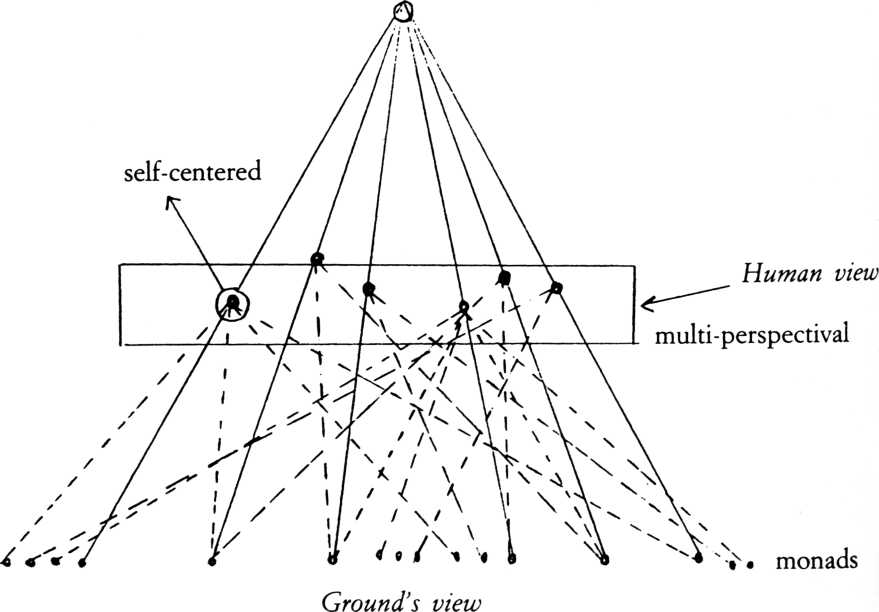
At bottom, each individual substance, from its own point of view,
strives to achieve
as much clarity as possible regarding the complete struc-
ture and richness of the
universe. It is immersed in a mass of stimuli - its
inner experiences - out of which
those relating to its immediate surround-
ings are stronger and presumably also
clearer. Initially, it has therefore,
mainly “local” knowledge, of little “general”
value. We might call this situ-
ation “the ground view”. At the other extreme, the
“top”, lies God’s eye
view of the universe. It encompasses all of the universe, in
all its rich vari-
ety, with perfect clarity. Due to their epistemic limitations,
individual sub-
stances cannot, of course, reach the top. Their problem is to
approach the
top as much and as effectively as they can.
One possibility consists in trying to do that, as it were, in a
straight
quasi-vertical line, by deepening one’s self-awareness. Through this
“analyt-
ic” procedure, a given monad would come closer to knowing its own
unify-
ing principle, the “inner law” or “axiom” that defines its “point of
view”,
and according to which it unfolds in synchrony with the other created
be-
ings - whose nature and behavior would thereby be explained through
the
clarification of their representations in the knowing monad. This
strategy
would, thus, aspire to derive its explanatory power from the very core
of
metaphysical reality, and its unity from the deep and direct knowledge
of
metaphysical units.
Another possibility consists in proceeding, as it were, in a multi-linear
way.
Instead of focusing on its own point of view and attempting to dis-
close its inner
law, whence it would finally learn about its fellow monads,
the monad striving for
knowledge would attempt to elevate itself above the
ground view by incorporating
from the outset as much as it can from the
experiences of its fellows. Progress
would consist in encompassing an in-
creasing variety of perceptions coming from
different points of view and in
providing successive “syntheses” of them. Rather
than seeking to derive
knowledge directly from an acquaintance with metaphysical
units, it would
address the layer of phenomena, through which it would then
indirectly
lead to knowledge about metaphysical units.
None of these strategies would, of course, reach the top. Due to human
limitations,
both would be able to reach only some intermediary level of
knowledge. But in their
rise towards the top, each of them would seem to
emulate primarily (stepwise and
partially, of course) a different subset of
the aspects of God’s vision: the former,
simplicity, parsimony of causes, de-
ductive architecture, and ultimate reality; the
latter, variety, exhuberance of
effects, inter-connected architecture, and reflected
or representational reality.
The two strategies do not exclude each other, and there is no princi-
pled metaphysical reason to assume that Leibniz should prefer or
recom-
mend the one over the other. After all, if the aim is to attain knowledge of
reality
and if God’s eye view represents the perfection of such a knowledge,
we should
strive to emulate all of its aspects. The best way to achieve
this
would seem to be the complementary use of both strategies. And
indeed,
there are indications that he proceeded in this way. For example, he
con-
tended that the correct method should include both
“analysis” and “synthe-
sis”, each of them valuable both for
discovery and for validation, as well as
for exposition and learning.
23
I would like to illustrate the complementarity of the two strategies by
an example
taken from a text where the issue is not scientific method per
se, but rather the relationship between reason, faith, and moral
action.
The Conversation du Marquis de Pianese Ministre d’Etat de Savoye,
et
du Père Emery Erémite: qui a esté suivie d’un grand changement dans la
vie
de ce ministre; ou Dialogue de l’application
qu’on
doit avoir à son salut
24
(VE
1786-1823) deals with the question of how to overcome a courtier’s
skepti-
cism (which led him to moral indifference) in order to restore his
religious
conviction, to sustain it, and to provide guidance for his moral conduct.
Os-
tensively, the dialogue confronts two characters - a high ranking
minister
and a famous theologian-hermit.
25
I think it can be safely assumed, however,
that both
represent different “voices” of Leibniz, who argues here with
himself,
polyphonically. This text offers, thus, a touching testimony of Leib-
niz’s own
dilemmas and of the advice he gives to himself.
After having skirmished successfully against the politician’s skeptical
arguments,
the hermit undertakes to satisfy the politician’s request for ad-
vice on how to
sustain the state of happiness he feels due to the restoration
of his faith. He
proposes two types of means for this purpose, the one “in-
ternar’, the other
“external”, which he calls, respectively, “prayer” and
“practice”. He defines prayer as “the perpetual search of solid reasons that
make
God appear great and lovable to you” (VE 1814). This consists
mainly in disclosing
everywhere the “orders, liaisons, and beautiful progres-
sions in all things”, as in
“the marvellous harmonies of mathematics and in
those inimitable machines invented
by God, which nature reveals to our
eyes”. Such observations permit one to “see God
through the senses,
whereas elsewhere one sees Him only through the understanding”
(VE
1815). But prayer also includes becoming aware of evil, injustice,
failure
and error, and being able to explain them. First, by reminding onself of
the
limitations of our “rules of prudence, since we cannot think of
everything
and be informed of everything” (VE 1814). Then, by concluding that,
since
- unlike us - God takes into account the global economy of the
universe,
“there is no evil which should not serve to a greater good” (VE 1814).
The
“internal” activity of prayer consists thus in a reflection on external
events,
with the aim of harmonizing them with - and thereby confirming - a
previ-
ously formed belief in the rationality and justice of God’s harmonious
cre-
ation. It is an activity of meditation upon one’s experiences, designed to
re-
inforce one’s conviction, an activity oriented towards belief confirmation
rather than towards belief formation.
“External practice” should “infallibly follow from a sincere interior”
(VE 1815).
Since, however, we cannot know the details of God’s will, we
must act as best we can
on the basis of our own judgment, guided by gen-
eral principles whose validity is
undisputable. The most important of these
principles is that of charity. “True
charity - Leibniz emphasizes - includes
all men, even our enemies” (VE 1815); “one
must have a good opinion
about everyone, as much as reason permits”; “one must even
love each per-
son in proportion to the good qualities that remain in him, for there
is no
man devoid of many good qualities [and] we don’t know what judgment
God
makes about him - maybe [it is] completely different from ours, for
we are misled by
appearances” (VE 1819). Fortunately we have the means
to act on the basis of
appearances, namely a “logic that discerns the degrees
of appearances of good and
bad [deeds] in order to [let us] choose those
that are more feasible and suitable to
be performed” (VE 1821). Thanks to
this logic, we are able to implement the
principle of charity, which requires
one to take into account “not only [one’s]
desires, but also those of the
others”, “to listen attentively to their motives and
to weigh them carefully”
(VE 1820).
26 Uncertainty, therefore, should not serve as an excuse for inac-
tion: “when there is some appearance of well doing, let us engage ourselves
in
action, without waiting for all the indications of infallible success”
(VE
1817).
So, the “external practice” described by Leibniz does not simply
“flow” from
internal conviction; nor does it depend upon its presumable
certainty. In fact, it
is possible thanks to the existence of a set of epistemo-
logical “helps” designed
to overcome the lack of certainty (which is one of
our epistemic limitations) and
permit the formation of beliefs capable of di-
recting
reasonable actions. Unlike the self-oriented activity of self-convic-
tion, the
helps that inform such actions are essentially other-oriented, in the
sense that
they rely upon perspectives other than one’s own for the forma-
tion of one’s
beliefs. In addition to the principle of charity, which requires
us to take into
account the “point of view of the other”,
27 and to the “logic
of appearances”, which permits the weighing of different
opinions, this
other-orientation (which is characteristic of the multi-perspectival
epistemo-
logical strategy) is apparent also in some of the concrete “rules” for
orga-
nizing one’s intellectual work proposed by Leibniz towards the end of the
Conversation (VE 1817-1819). The first of these rules recommends
finding
an appropriate “companion of studies”; the second suggests writing down
a
detailed project of action for oneself, similar to the “instructions one
usu-
ally gives to public ministers”;
28 the fifth, to maintain a list of “all that can
be of help, including useful
thoughts”, to have always at one’s disposal
leaflets of paper for “noting down
quickly whatever is worthwhile remem-
bering in reading, conversing, working, or
meditating”; the seventh elabo-
rates once more upon the rule of charity.
One senses in these rules the realities and needs of Leibniz’s own
modus operandi: he collects every bit of relevant information
from every
possible source; he records all his thoughts; makes notes on everything
he
reads or hears; he writes down dozens of plans and projeets; he
proposes
devices for ordering the collected material, for helping his memory,
for
forcing himself to carry on his own plans; he needs an efficient
secretary
as well as a reliable companion not only to help him in all this but also
to
contribute “something of his own” to the huge enterprise, which cannot
but be collective.
29 But there are also rules which are are entirely self-ori-
ented: the fourth
urges a reasonable distribution of one’s time, which
should include some time for
meditation; the third recommends checking
daily the pursuit of one’s project; the
sixth speaks of controlling one’s pas-
sions so that they don’t interfere with the
use of reason. As a whole, these
rules, which are designed to implement both
“prayer” and “practice”, il-
lustrate the intermingling of the two epistemological
strategies. They show
the complementary orientations of a mind eager not to miss any
of the
rich variety of the world, reflected in the thoughts and wishes of other
hu-
man beings (“Things have so many faces!” - he exclaims; VE 1822), while
at
the same time trying to keep it all under control by carefully managing
its most
precious resource - attention (“God gives men attention, and at-
tention makes it
all”; ibid.).
30
In one of its senses, then, the expression “epistemological diversity”
should refer
to the complementary use of the two epistemological strategies
discussed in the
preceding section. In another sense, applicable particularly
to the
multi-perspectival strategy, the expression refers more specifically to
the
implications of having to handle the variety of theories, methods, and
sources of
knowledge with which a truly “cooperative”, epistemically limit-
ed, human knowledge
seeker must cope. Some of these implication for
Leibniz’s epistemic practices were
already mentioned in the preceding sec-
tion. I will now examine other aspects of
Leibniz’s work in the light of his
use of this particular epistemological
strategy.
First, the multi-perspectival strategy has, as we have seen, a “public”
dimension
which implies that it cannot be seriously pursued without a seri-
ous and sustained
collective investment. If scientists are supposed to coop-
erate in the production
of knowledge, they are supposed to have (and to
develop) the means necessary for
organized cooperation. That is to say,
some sort of institutionalization, eventually in the form of scientific
academies,
is needed. The “companion of studies” must become a team of
researchers; the
gathering of data from all over the world involves the acti-
vation of field
workers, the sending of missions to remote regions, the ob-
tention of permission
and support of local rulers; a system for cataloguing,
archiving, and indexing
documents and other forms of information must be
devised and as widely as possible
strictly enforced; a standard language -
preferably universal - for representing and
transmitting such information,
must be put together; scientific journals should see
to it that the informa-
tion is widely disseminated; encyclopedias, compendia, and
other forms of
systematic organization of information must be compiled, in order to
make
extant knowledge readily available and to avoid duplication of efforts;
and
so on. These and other life-long leibnizian projects no doubt stem from
the
fact that he took very seriously the multi-perspectival epistemological
strat-
egy, and can be understood in its light.
Second, the multi-perspectival strategy is intimately tied to the develop-
ment and
use of a rigorous comparative method. Different points of view
provide different
views of the “same” phenomenon, and it is through their
comparison that we can
discover order, invariance, lawfulness, and, ulti-
mately, truth and unity. Thus,
one can discern the common roots of all lan-
guages only by comparing many
languages;
31 similarly, it is through the com-
parative study of the ensemble of
languages that one can learn about the
“operations of the mind” they mirror;
32 and, within one language, in order
to find the meaning of an expression, one
should collect all the different lo-
cutions where it appears, including its
metaphorical uses, in order to form a
hypothesis about its meaning.
33 Through the comparison of multiple repre-
sentations, we can overcome the
arbitrariness that might be involved in
single representation.
34 The broader the comparative basis, i.e., the more
perspectives one takes
into account, the better the chances of elevating our-
selves above the “ground
level” by generating reasonable hypotheses which
provide an increasingly synoptic
and comprehensive view of things.
Third, the epistemic value of the guiding principle of the multi-per-
spectival
strategy, which demands one to try to see things from “the place
of the other” lies
in the fact that such a “place” is different from ours.
Such
a difference should not be obliterated by the need to coordinate the
re-
search effort, but rather carefully preserved. The community of
researchers,
therefore, should not behave like a cohort of yes-men, entirely
subservient
to the director of the project. Although the aim of the joint effort is
ulti-
mately to disclose the consensus, convenientia, or harmony between the vari-
ous points of view, it would be
ill-served by disregarding from the outset
divergence and difference. Instead, one
should look for outlooks widely dif-
fering from ours, in their basic assumptions,
cultural framework, temporal
and spatial distance, methodological procedures, etc.
This is why we have
much to learn from the Ancients, the Chinese, the American
Indians, as
well as from the Scholastics, the Mystics, and every other tradition.
Further-
more, none of them can be excluded a priori as being
entirely erroneous
and therefore worthless. Some parcel of truth must be among the
“good
things” that must be found in them, according to the principle of
charity,
for their perspectives provide, within their limitations, truthful
representa-
tions of the universe. These must be somehow incorporated in a
compre-
hensive account thereof. Leibniz was well aware of the difficulties
involved
in reconciling wide apart and apparently conflicting conceptual
frame-
works. His interpretation of Confucianism as a “civil cult”,
35 which would
permit its peaceful coexistence with Christianity, was finally
rejected by the
church, and he didn’t succeed in persuading much closer traditions,
such as
Protestants and Catholics, and even the Protestants among themselves,
to
accept the common ground he proposed for reuniting them. But such fail-
ures
only confirmed Leibniz’s pessimism about people’s resolve to employ
wisely their
energies and make the mental effort necessary to overcome the
limitations of their
points of view (which include, of course, their way of
understanding their own interests).
36 Nevertheless, he believed reconcilia-
tion of apparently conflicting
doctrines was possible in principle, though it
requires sustained attention, i.e.,
“application”. Therefore he didn’t give up,
and his fame as a man capable of
detecting the truthful contributions of
diverging doctrines and integrating them, at
least in philosophy and the
sciences, became widely recognized.
37
Fourth, the difference of points of view often manifests itself in the
form of
mutual criticism, which may lead to disputes and controversies. Un-
like
“meditative” thinkers, like Malebranche, who considered public de-
bates as
disturbances that deviated them from their self-centered task
of
system-building,
38 Leibniz did not dismiss them as irrelevant or pernicious
for the advancement
of knowledge. He in fact thrived in debate, and sought
it actively. Provided, of
course, debate is taken seriously as a way of advanc-
ing knowledge, and not as a
kind of amusement.
39 And seriously indeed he
took it. Not only did he engage in public and
private controversies with
major thinkers of the time, to which he even devoted his
two major philo-
sophical books, but throughout all of his life he strived to
develop a theory
of controversies and a method to resolve them. The widespread
belief that
such a method would consist in a mere application of the Characteristica
Universalis, which would allow to resolve
controversies by straightforward
“calculation”, overlooks the vast amount of
writings where Leibniz, draw-
ing from his juridical, theological, logical,
probabilistic, hermeneutical, and
political work, undertakes to develop the means to deal with controversies
that
cannot be strictly formalized and resolved by simple calculation.
40
I think Leibniz’s deep interest in controversy is directly related to
the
multi-perspectival epistemological strategy. Mainly because it is in
(seriously
conducted) controversies that the differences of “points of view” are
sharp-
ened, clarified, understood, and eventually appropriated for the
construc-
tion of more integrative theories. When properly conducted, a
controversy
forces one to fully appreciate the force of the opponent’s arguments, in
or-
der either to rebuff them properly or to modify one’s own position on
their
strength. In this sense, it is in controversy that one fully implements the
de-
mand of positioning oneself in “the place of the other” and thereby to
tran-
scend one’s “mental set”. Furthermore, if one is able to disengage
oneself
from a partisan attitude and, even while taking part in a controversy,
regard
it as a “disinterested judge”, then one has the opportunity of envisaging
the
object of the dispute from all sides
(“faire le tour de la chose” is the beauti-
ful
phrase employed by Leibniz), to weigh conscientiously the pros and
cons before one
adopts one side or the other.
41 In so doing, one elevates
oneself to a position whence one can benefit fully
from the conflicting per-
spectives, and make a significant step towards the top of
the diagram in
Figure 1. The very existence of and actual participation in serious
contro-
versies is, thus, a privileged and specific contribution to the
implementation
of the multi-perspectival strategy, which is not available to a
solitary practi-
tioner of the self-centered strategy. In addition to that, a theory
of contro-
versies, which would develop Leibniz’s dream of an encompassing
“new
logic”, whose broader notion of “form” would include the principles
and
methods for “weighing” conflicting arguments, would become an invalu-
able
epistemological tool for the success of that strategy.
Maybe what we have been doing in this paper - and in this colloquium -
namely,
searching for the unity of Leibniz’s system/thought is based on a
big mistake. For
we sort of assumed that, if the world that the system is
supposed to describe has
some unity, then the system too should have one.
But true unity, the unity that
characterizes “reality”, says Leibniz, is sub-
stantial
unity. In a letter to Arnauld, he warns us not to attribute unity of
this
kind to mere “abstractions of the mind” (GP II, 101), to those “fic-
tions of the
mind” (p. 102) we tend to carelessly assume to be reai. They re-
sult from the
tendency of the mind to grant reality, i.e., unity, to whatever
can be “combined in
thought and given a name” (p. 101). But this in no
way can lead us to “establish
solid and real principles” (p. 102), which must
be based on the identification of
“truly accomplished beings or substances”
(p. 102). As long as we have not done
this, we are dealing merely with
“phenomena, abstractions or relations”, i.e., with
“beings by aggregation”
(p. 101).
What, then, if the system is nothing but an abstraction, a set of rela-
tions, an
aggregate of propositions lacking “substantial unity”? As a cre-
ation of a mind,
however powerful and clever it may be, a philosophical
system is unlikely to be much
more than that. But then, it belongs to the
realm of phenomena, and its unity cannot
therefore be of the same kind as
the metaphysical unity underlying reality. That is
to say, whatever unity a
system has cannot be more than the “accidental unity”
typical of phenom-
ena. Far from despising this kind of unity, however, Leibniz
acknowledges
its existence and importance. He claims, for example, that there is
truth in
phenomena (GP II, 521); that this truth consists in the “consensus”
of
many perceptions (ibid.). He is interested in finding laws
(= unity?) in phe-
nomena. He admits the existence of different degrees of
accidental unity, all
of which derive from thoughts and appearances, a fact that
does not
prevent us from calling them “real”.
43
So, if the system is barred from having “substantial unity”, i.e., of actu-
ally
mirroring monadically the unity of the universe, whatever unity it may
aspire to have is that of the highest degree phenomena or aggregates are ca-
pable
of. The criterion is the “amount of inter-relations between the ingre-
dients”: the
more there are such relations, the more appropriate it is to con-
sider an aggregate
as possessing “unity”. “More” here must mean - accord-
ing to Leibniz’s Principle of
Sufficient Reason - not merely “many” but
“many different”. And “different” must
mean coming not only from one
point of view or monad, but from many. Thus, a system
built according to
the multi-perspectival strategy, as a cooperative enterprise of
many minds,
which emphasizes precisely the multiplicity of sources of knowledge
and
hence of their relations, stands a good chance to reach a high degree
of
unity, by this criterion. But Leibniz seems to have in mind additional
crite-
ria. For example, a shared design or intention. By this criterion, a group
of
individual acting under a common (set of) intention(s) is an aggregate
en-
dowed with more unity than, say, a mound of stones, whose only connec-
tion
is physical contact. Again, none of these aggregates has anything even
remotely
similar to substantial unity, but still, it is more appropriate to see
unity in the
former than in the latter.
44 There are, then, some relations (e.g.,
intentionality) that weigh more than
others (e.g., physical contact) in assess-
ing the unity of an aggregate.
This might lead one to think that a system developed through the self-
centered
strategy would also have a fairly high degree of unity, since it
is likely to
reflect the unifying effect of it author’s design. Would such a
system’s unity be
higher than that of its multi-perspectival competitor? It
seems to me that,
regardless of the weight Leibniz assigns to each of the
two criteria, the scales
would favor the latter. For we should not forget that
intentionality is itself
multiplied by the cooperative work involved in the
multi-perspectival strategy. So,
a system based on the self-centered strategy
would definitely lie somewhere in
between: it would certainly have more
unity than that of a mound of stones, for it
would be based on the suppos-
edly unitary intentionality of its creator; but it
would be bound to display
an impoverished texture of relations and variations if
compared to a system
produced by a cohort of savants, united
by a common purpose, and keep-
ing their independence of mind and their particular
perspectives on things.
Once we place the system where it belongs - the phenomenal
world - the
self-centered strategy seems thus to be inferior, according to Leibniz’s
crite-
ria, to its multi-perspectival counterpart, for it can at best yield a lesser
de-
gree of “accidental unity”. Whoever insists in privileging that strategy, or
in
attempting to find in a system some higher, substantial unity, bears the
bur-
den of proof.
45
Beyssade, J.-M. 1994. “Méditer, objecter, repondre”. In Beyssade
and Marion (eds.),
pp. 21-38.
Beyssade, J.-M. and Marion, J.-L. (eds.). 1994.
Descartes: Objecter et repondre.
Paris:
Presses Universitaires de France.
Couturat, L. 1901. La Logique de Leibniz. Paris: Presses Universitaires de France.
Dascal, M. 1978. La Sémiologie de Leibniz. Paris: Aubier-Montaigne.
Dascal, M. 1987. Leibniz. Language, Signs, and Tbougbt. Amsterdam: John Benjamins.
Dascal, M. 1990a. “The controversy about ideas and the ideas
about controversy”. In F.
Gil (ed.),
Scientific and Philosophical Controversies.
Lisboa: Fragmentos, pp. 61-
100
.
Dascal, M. 1990b. “Leibniz on particles: Linguistic form and
comparatism”. In T. de
Mauro and L. Formigari (eds.),
Leibniz, Humboldt, and the Origins of Compara-
tivism.
Amsterdam: John Benjamins, pp. 31-60
Dascal, M. 1993. “One Adam and many cultures: The role of
political pluralism in the
best of possible worlds”. In M. Dascal and E. Yakira
(eds.),
Leibniz and Adam.
Tel
Aviv: University Publishing Projects, pp. 387-409.
Dascal, M. 1994a. “Le langage dans la maison de l’esprit: une
tirade de parallèles”. In
Q. Racionero and C. Roldan (eds.),
G. W. Leibniz: Analogia y Expresión.
Madrid:
Editorial Complutense, pp. 57-77.
Dascal, M. 1994b. “Strategies of dispute and ethics: Du tort and
La place d’autruy. In
Leibniz und Europa (VI. Internationales Leibniz-Kongress), Vortrage II. Teil, pp.
108-115.
Dascal, M. 1995. “Epistemologia, controversias y pragmàtica”. Isegoria 12: 8-43.
Dascal, M. 1996. “La balanza de la razón”. In O. Nudler (ed.),
La racionalidad: su poder
y sus limites.
Buenos Aires: Paidós, pp. 363-381.
Dascal, M. 1997. “Critique without critics?”. Science in Context 10: 39-62.
Dascal, M. and Gruengard, O. (eds.) 1989.
Knowledge and Politics: Case Studies in the
Relationship between Epistemology
and Political Philosophy. Boulder: Westview
Press.
Dawkins, R. 1976. The Selfish Gene. Oxford: Oxford University Press.
Hoffmann, R. and Leibnowitz Schmidt, S. 1998.
Old Wine in New Flasks: Reflections
on Science and Jewish
Tradition.
New York: W. H. Freeman.
Malebranche, N. [1979].
Oeuvres, vol. I.
Ed. by Geneviève Rodis-Lewis. Paris: Galli-
mard.
Marion, J.-L. 1994.
“
Le statut originairement responsorial des
Méditations
In
Beyssade and Marion (eds.), pp. 3-19.
Serres, M. 1968.
Le système de Leibniz et ses modèles mathématique,
2 vols. Paris:
Presses Universitaires de France.
“...for we are only humans” (Leibniz; C, 40). All the translations of
Leibniz’s quotations
are mine, except when a reference to a translation is
also given.